
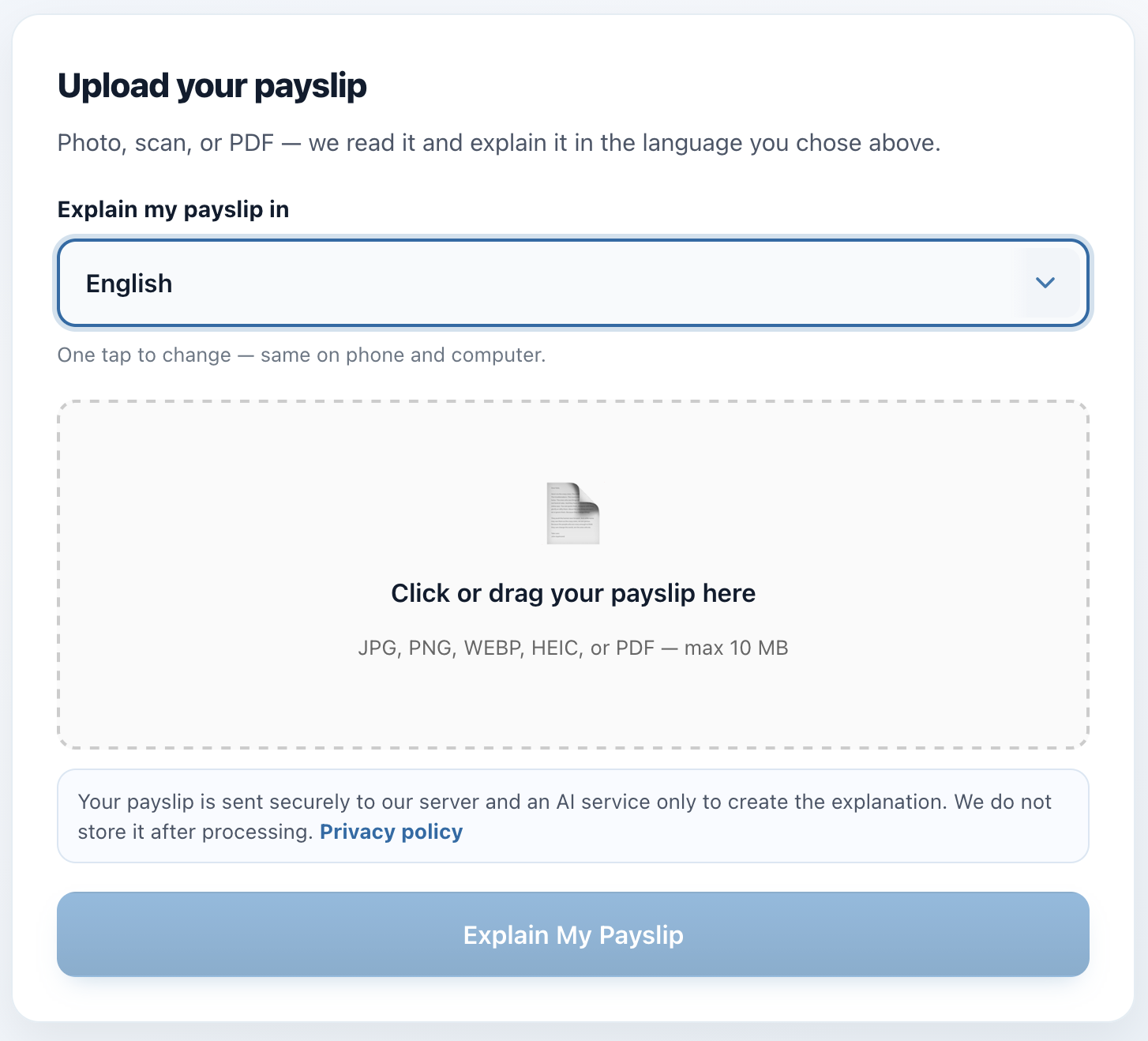
Your first Italian busta paga (payslip) can look like a wall of abbreviations and numbers that don't obviously connect to the amount that actually lands in your bank account. I built BustaFacile specifically to translate this into plain language across five languages — here's the short version of what each part means.
Gross vs. net: the two numbers that matter most
Retribuzione lorda (gross pay) is your salary before any deductions — this is usually the number quoted in your job offer. Netto in busta (net pay) is what actually gets paid to you, after taxes and social security contributions are subtracted. The gap between the two is often bigger than people expect — commonly 25-35% depending on income level.
INPS contributions
INPS (Istituto Nazionale della Previdenza Sociale) contributions fund your pension and social security. You'll see a percentage deducted from your gross pay (typically around 9.19% for most employees) that goes toward your future pension — your employer also contributes a separate, larger amount on top, which doesn't come out of your visible pay but is part of your total employment cost.
IRPEF: the income tax
IRPEF (Imposta sul Reddito delle Persone Fisiche) is Italy's progressive income tax, calculated in brackets — the more you earn, the higher the rate on each additional bracket of income. Your payslip shows the IRPEF withheld for that pay period, calculated on your taxable income (gross pay minus INPS contributions).
Detrazioni: tax credits that reduce what you owe
This is the part people most often miss. Detrazioni (tax deductions/credits) reduce your actual tax bill based on factors like: being an employee (rather than self-employed), having dependent family members, or specific expense categories. If your detrazioni look unusually low, it's worth checking with HR that your family situation is correctly registered — this can meaningfully change your net pay.
Other common line items
- TFR (Trattamento di Fine Rapporto): severance pay accrued monthly, paid out when you leave the company.
- Addizionale regionale/comunale: small regional and municipal income tax surcharges.
- Assegno unico: a family allowance for parents, if applicable, sometimes shown separately.
- Ferie e permessi: your accrued vacation days and paid leave balance.
Why this matters beyond curiosity
Understanding your payslip isn't just informational — it's how you catch payroll errors, verify your pension contributions are correct, and understand what changes (a raise, a new dependent, a contract change) will actually do to your take-home pay.
How BustaFacile helps
BustaFacile uses AI to explain your specific payslip line by line, in Bengali, English, Urdu, Hindi or Italian — no need to guess what an abbreviation means or ask a colleague to translate. Available on iOS and Android.